Showing posts with label Book Report. Show all posts

Wednesday, May 14, 2008

Book Report: Shakedown

Title: Shakedown

Author: Joel Goldman

Synopsis:
Kansas City FBI Agent Jack Davis cuts corners and calls in favors to piece together seemingly unrelated clues in a mass murder while battling a debilitating nerve condition that has cost him his job.

My thoughts:
This blog has benefited me in a number of ways. It has allowed me to meet some really fun and talented people. It has given me a creative outlet (though, admittedly, the "creative" bit is debatable). But the real reason I started it is to try to get free stuff.

My first score on this point was a review copy of the That Thing You Do director's cut.

And most recently when I received an invitation to review Shakedown by local author and trial lawyer Joel Goldman I jumped at the opportunity. Who am I to turn down a free review copy of the book?

Shakedown is Goldman's fifth book and takes place in various neighborhoods throughout the greater Kansas City area. Genre-wise, I guess you would call it a crime/suspense thriller, which isn't really what I usually go for. Still I was excited to dive in and give it an honest try.

I was a little concerned in the first couple of chapters where the author used, in my opinion clumsily, a written street vernacular for the inner dialogs of some minor characters. This was soon forgiven though, as I came to appreciate the pace of action in the story.

I also appreciated Goldman's use of the Kansas City area as a character device in the novel. He does an excellent job of describing the different neighborhoods, from the tough and gritty Quindaro, Strawberry Hill and the rail yards in Argentine to the upscale Country Club Plaza shopping district and the suburbs of Johnson County.

Goldman also peppers in several literary Easter Eggs for his Kansas City readers. The main character, for example, uses the alias of "Detective Funkhouser" in some scenes, an obvious reference to the KCMO mayor.

I also was interested in the way Goldman incorporated aspects of another book I recently read, Malcom Gladwell's Blink. One of the main characters is an expert in the Facial Action Coding System (which Gladwell discusses in detail in his book) and uses this skill to help solve the murder. But it ends up costing her.

The writing is solid and the narrative tight enough to keep me turning the pages. I thought the plot was a bit contrived at times, and several sequences were easily predicted.

But I’d still give it a solid recommendation for your summer reading list, especially for those of you in Kansas City. Add it to your beach bag or take it on that road trip. It’s a good read.

Rating: Recommended summer/beach reading

Note: Read more 3AM Book Reviews.

tagged: , , , , , , ,

Thursday, May 08, 2008

Book Report: Blink: The Power of Thinking Without Thinking

Title: Blink: The Power of Thinking Without Thinking

Author: Malcolm Gladwell

Synopsis:
Blink is a non-fiction essay about the ability of the human mind to make highly accurate snap judgments, the process by which we make these kinds of judgments and pitfalls and dangers that can occur when we don't realize what influences this kind of decision making.

My thoughts:
This book was highly recommended to me by many people. Several of my managers at work are Gladwell disciples and have also recommended his earlier work The Tipping Point.

There are also some pretty smart bloggers out there who recommended Blink as well as one of my favorite football coaches.

So why all of the acclaim? Well, for one thing this is a really well written piece of non-fiction. Gladwell covers several case studies where split second decision making has been successful and where it has led horrible, tragic mistakes.

Case studies run the gamut from marriage to military games (not much difference there, right?) and from fine art to speed dating.

Gladwelll introduces fancy terms like "rapid cognition" and "thin slicing" that and explains them in a clear and entertaining way.

There is also a fascinating discussion of facial expressions, or rather the various component parts of facial expressions made up by the various individual movements of facial muscles.

Microexpressions, as they are called, can involuntarily reveal a glimpse of a person's true emotional state to the trained observer.

And interestingly, just as emotional states cause these involuntary facial movements, voluntarily producing certain facial movement can influence one's emotional state. It's a two way street.

Gladwell's writing style is conversational and easy to read, a reflection no doubt of his time in the newspaper world.

It's a fast 320-page read and the insights into how our minds work (or don't work, in some cases) makes it well worth your time.

Rating: Recommended

Note: Read additional 3AM Book Reviews here.

tagged: , , , , , ,

Friday, February 22, 2008

Book Report: A Thousand Splendid Suns

Title: A Thousand Splendid Suns

Author: Khaled Hosseini

Synopsis:
The story follows the lives of two Afghan women, Mariam and Laila, who become caught up in the repression and misogyny of conservative Islamic culture.

Events span the decades from the rule of Afghan kings, the Soviet invasion, the civil war of the Mujahideen warlords, the takeover of the Taliban and the eventual liberation by Allied forces.

It gives compelling details about the tragic struggles and sacrifices of the two principal characters as they try to survive through anarchy and extremism in what would become a brutalizing culture.

My thoughts:
The first to-do item on my literary list this year was to work my way through the entire Khaled Hosseini library. Luckily for me, that is comprised of only two books at this point. The Kite Runner, which was released earlier this year as a motion picture, and A Thousand Splendid Suns.

I'll try steer away from comparing the two books here. They're both very good reads and worth your time. But I will say that I consider Suns to be the better of the two.

The author's narrative style is stronger and less predictable and he stretches himself, very effectively, to look at the events of the last 35 years in Afghanistan from a woman's point of view.

Hosseini does an excellent job of referencing the global and regional political issues in the story without making them a main plot point. The large events are a backdrop, a scene setting device that serves as a canvass for the personal tribulations the main characters endure.

In doing this, the he avoids being overtly preachy and opinionated. The result is a narrative that keeps it's focus on the subjects of the story, while exposing the reader to the cultural and moral pitfalls of Afghanistan during this time frame and, more generally, of any authoritarian society.

The story itself gives me new respect for the struggle of the Afghan people, particularly the women, and what they have endured over the past four decades. One point the story makes is that nobody in Afghanistan has escaped loss -- loss of family members, loss of friends, loss of limbs, loss of dignity and loss of life.

After the first few chapters I was already wondering if life would ever get better for the women involved. And it didn't. It gets worse and worse for most of the book. This is another reason I respect Hosseini as a writer. He doesn't sugarcoat anything.

The lives of the main characters get progressively worse throughout the book and this is can be emotionally trying for the reader. But as with The Kite Runner, while you can't say that there is a happy ending, there is at least a hopeful ending.

Rating: Highly recommended

tagged: , , , , , ,

Thursday, November 01, 2007

Book Report: No Country for Old Men

Title: No Country for Old Men

Author: Cormac McCarthy

Synopsis:
While hunting in the West Texas wilderness, Llewelyn Moss stumbles upon the bloody scene of a drug deal gone bad. Invoking the "Finders Keepers" clause, he claims $2 million in cash (but leaves the heroin). He gets more than he expects when the Mexican drug cartel sends Anton Chigurh - a psychopath who is not quite as dangerous as the Bubonic Plague - to reclaim the money and "product."

My thoughts:
Since reading McCarthy's Pulitzer Prize winning The Road, I've been working my way through the McCarthy library. My goal was to finish No Country for Old Men before the motion picture release later this month.

It turns out that wasn't a problem. Like The Road, No Country is a very quick read at just over 300 pages. But while the book showcases McCarthy's gift for language, it wasn't as emotionally satisfying as The Road. I wasn't left with the sense of stunned awe after turning the last page as I was with The Road.

That said, No Country for Old Men is still and amazing work. It examines the old proverb that "No good deed ever goes unpunished." When the central character Llewelyn Moss stumbles upon the drug deal gone bad and the accompanying $2 million in untraceable cash (well, nearly untraceable), all he has to do is let a man die alone and walk away rich.

His better angels take over though, and he returns to the scene to give the dying man a drink of water. For this, he is rewarded with being chased through the desert by drug traffickers who have come to collect the money.

This sets up the major plot line for the novel, and McCarthy describes the chase with all the physical and psychological detail to which I've come accustomed through reading his other works (though stylistically McCarthy is in his Hemingway mode rather than his Faulkner mode). Anton Chigurh follows Moss and the money, leaving a trail of blown out door locks and blown out brains across the plains of west Texas, while Sheriff Ed Tom Bell tracks the carnage trying to figure out what kind of person could do such evil but questioning whether he really wants to catch up with the assassin.

I give McCarthy credit for not pulling punches in the story (although by now I know McCarthy pulls no punches when it comes to death and violent imagery). In the end, Chigurh catches up with Moss, kills him, takes the money and gets away. We are then treated to a chilling scene where Chigurh, for no reason other than his demented psychosis, kills Moss's widow because he told Moss he would.

No, it's not a happy ending (Oh, by the way, SPOILER ALERT!!! Heh, little late with that, sorry).

In the denouement, Sheriff Bell retires when he is unable to prevent the bloodbath or bring Chigurh to justice (or even identify who Chigurh is). He retires because it really has become no country for old men. Bell (and McCarthy?) suspects the moral decline and growing violence of the world around him is irreversible.
"It starts when you begin to overlook bad manners. Any time you quit hearin Sir and Mam the end is pretty much in sight."
My biggest problem with the book is that there are a couple of pretty big plot holes. One is, why did Moss, after taking the money, decide to risk discovery by returning to the scene? I suppose it was because he felt conflicted about leaving someone to die thirsty and alone, but this humanitarian action doesn't seem consistent with his later actions. I can live with this since it sets up the conflict and action for the rest of the story.

My bigger gripe is with the Moss's death scene, or rather the lack of one. We are brought to the scene after the fact with the character of Sheriff Bell. I just think that after investing so much to develop Moss's character, he deserved a better, more detailed death sequence.

Still this is a profound and disturbing book, well written and very approachable. I hope the Coen brothers have done it justice (and from what I've read, they have).

Rating: Recommended.

tagged: , , , ,

Friday, July 06, 2007

Book Report: The Subterraneans

I've been meaning to get this one out for a several weeks now.

Title: The Subterraneans

Author: Jack Kerouac

Synopsis:
Boy meets girl. Boy and girl fall in love. Boy screws it up due to his self-destructive tendencies. Set against a backdrop of a 1950s bohemian beat San Francisco artistic underground.

My thoughts:
Can you believe that I've been reading for 30 years and I've never read a novel by Kerouac? Well, up until about a month ago, that was the case.

It was a dirty little secret that I'd kept hidden away from my hipster friends. But now I can come clean.

I picked up The Subterraneans because I didn't know exactly what I'd be getting into with a Kerouac novel. I mean, I had some ideas. He is kind of legendary after all. But I didn't want to bite off more than I could chew, so I picked this novel because it's only 111 pages.

The plot is pretty simple. Leo Percepied falls in love with the beautiful Mardou Fox. He woo's her, wins her and then proceeds to undermine their budding relationship with a string of self-destructive abuses. He realizes his love for her too late, after he has already driven her away and into the arms of another member of the San Francisco underground.

Of course in a Kerouac novel like this, the plot isn't the main thing. Kerouac is known for his revolutionary style of writing and this book has it in spades.

Coming to Kerouac from McCarthy's The Road was a bit shocking. The Road is written in short declarative sentences. Anything extraneous is left out.

The Subterraneans on the other hand showcases Kerouac's jazzy, improvisational slang-laden stream-of-consciousness prose. It took a few pages to adjust my internal dialog to the 1950s sub-cultural vernacular and adapt to the pacing and rhythm of Kerouac's writing.

But once made, that adjustment allowed me to appreciate Kerouac's knack for writing. He definitely has a well-deserved reputation of having a way with words.

...the little white woolly particles from the pillow stuffing in her black almost wiry hair, and her puffed cheeks and little puffed lips, the gloom and dank of Heavenly Lane, and once more "I gotta go home, straighten out"- as tho never I was straight with her but crooked..."
The story is told in the tone of a literary genius who knows he's a literary genius but also knows that being a literary genius still doesn't make him any less of a sonuvabitch.

The interesting rhythm and word choices, the pacing and imagery all made this a quick and enjoyable read. I feel better now about taking a bigger bite of Kerouac and plan to in the near future.

Favorite quote:

"... the great tumescent turbulent turmoil alliterative as a hammer on the brain bone bag and balls, bang I'm sorry I was ever born..."
Rating: Recommended.

tagged: , , , , , ,

Wednesday, May 16, 2007

Book Report: The Blind Side


Title: The Blind Side: Evolution of a Game
Author: Michael Lewis, author of Moneyball: The Art of Winning an Unfair Game

Synopsis:
Through an amazing and rare series of events, a young man from the ghettos of Memphis changes his destiny, avoiding an almost certain short life in a drug gang to become one of the most anticipated potential NFL players in years.

My thoughts:
In The Blind Side, Michael Lewis relates the story of a young kid, Michael Oher, who suffers from every conceivable social disadvantage in life except for the fact that his substantial physical gifts make him uniquely suited to play the second-most important position on the college/NFL football team: left tackle.

Lewis gives a good primer on how the left tackle position became such an important role on the team. Starting with the career ending leg injury suffered by Joe Theismann on national television in 1984 through the current day NFL where some left tackles get paid more that quarterbacks, Lewis walks us through some of the reasons why "In football, as in real life, the value we place on people changes with the rules of the game they play."

But this football primer is really just to set the background for the story of Oher. Faced with the huge hurdles of race, poverty and lack of education, Oher finds a way to leverage his one advantage: That he hit the genetic lottery.

It turns out that, through the chance of natural selection or a gift of god, Oher has the body of a prototypical NFL left tackle. If he can only overcome his lack of education, a murdered father, a drug addicted mother, and a society that seems not even to know he exists, he has a chance to earn millions playing a game for which he seems specifically designed.

Luckily he meets a family in Memphis. A rich, white, evangelical Christian family no less, that takes him in, sees to his education and only then allows him to set off on his journey to the NFL.

There are many setbacks along the way as you can imagine, car accidents, academic troubles, even an investigation by the NCAA. But the story, like all good stories, ends with a beginning -- in this case the beginning of Oher’s football career. The next chapter will be written this fall, Oher’s junior season at Ole Miss and it’s one I'm keen to follow when football season starts.

The description of Oher's journey from the ghetto to a college scholarship and the stories of those who helped him along the way are very compelling. Lewis' writing is solid, and tends to get in the way of the story only rarely.

Rating: Recommended.

tagged: , , , , , , , ,

Monday, April 16, 2007

Book Report: The Road

All I can say is "wow" ... just... "wow"...

I bought Cormac McCarthy's latest opus The Road not because Oprah recently added it to the Oprah Book Cult, but because one of the smartest bloggers I know suggested it.

All of the comments I've heard about the story are true. It is dismal, and tragic and bleak. In fact, saying this story is bleak is like saying the Pope is a little bit Catholic. It's like calling Larry Moore "mature" (had to get a Larry Moore dig in there).

This is a raw cheerless book. And yet somehow, after consuming it in about a day and a half (I do have a job unfortunately) I wasn't depressed at all. In fact, quite the opposite.

In case you haven't heard about it yet, the story follows the struggles of an unnamed man and his young son as they trudge through a post-apocalyptic America on their way to the coast and what they hope will be a better life. Along the way, they face threats from starvation, freezing, sickness and (gulp) cannibals.

It seemed to me McCarthy was attempting to strip away everything but the essence of existence. He peeled off the unnecessary layers of luxury, money, success, power, religion (though not necessarily spirituality) and cheap sentimentality in an attempt to discuss the core issues of why we are here.

Reflective of this philosophy, the writing is sparse, like the landscape it is describing. Anything unessential has been left out -- even to the point of eliminating some punctuation and parts of sentences.

This is all to illustrate that there is one thing important in this story: The relationship between the man and his son. In the world that McCarthy has conjured, there is no reason to go on living other than their love for each other. They are "each other's world entire" as McCarthy writes.

And this is the hope and beauty of the story set in an altogether ugly world. That at the heart of everything, taking away all of that which we think is important, in the end love is what will sustain us.

There was much symbolism around the nature of God, good and evil, and all manner of ethical questions that smarter people than I will get into.

But for me, the book wasn't depressing. In fact, when I finished the final pages my only thought was that I wanted to pick up my 4-year-old daughter and give her a long hug.

And that's what I did.

Rating: Highly recommended


PS - I was remiss in omitting these excellent and insightful posts about The Road by other of the smartest bloggers I know:tagged: , , , ,

Wednesday, April 11, 2007

Book report: The Judgment of Paris

I don't really have room to complain. I've got a good job, wonderful family, nice house, tons of hipness.

But being this awesome does have its drawbacks.

For one thing, I don't have as much time for free reading as I used to have. That's why it has taken me two months to read the 375 pages of Ross King's The Judgment of Paris, which has been on my reading list since at least last August.

I was interested in this book for the subject matter (French art and the introduction of what became known as Impressionism), but also for the author. I had previously devoured King's Brunelleschi's Dome and was impressed with his ability to bring out the juice of history.

I wasn't disappointed in that regard with The Judgment of Paris. King has an ability to take the potentially dry dates and places of history and weave in the perspective and personality of the historical characters to make the events interesting and meaningful. In this way, for example, he connected the historical dots between the Battle of Puebla in Mexico (which gave us the Cinco de Mayo celebration) with the plight of starving French artists in 1860s Paris.
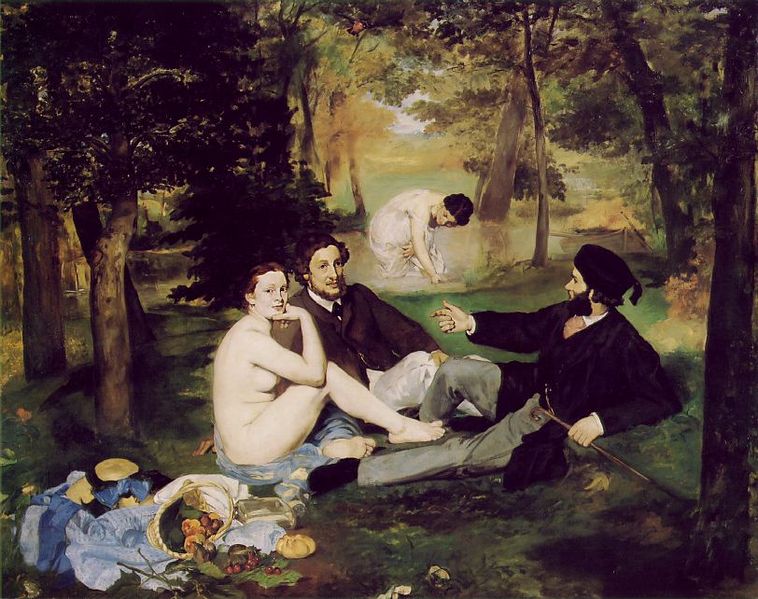
Le déjeuner sur l'herbe - Édouard Manet
The book chronicles and juxtaposes the lives of two Parsian artists through 1860s and 1870s France -- legend-in-his-own time Ernest Meissonier and legend-in-our-time Édouard Manet -- along with the social, political and cultural events of the time that produced artistic geniuses such as Monet, Degas, Cézanne, Renoir, Pissaro and others.

The account stresses the interrelatedness of events, attitudes and people and the affects of all of these on the course of artistic endeavor. It's not what I would call your typical Sunday afternoon page turner. The stories take an effort by the reader to keep track of names and time lines.

But the effort is paid off in an added interest and understanding of how and why the painters listed above became known as Impressionists (a pejorative term when first coined by Parisian art critics). It also gives a view, through the lens of history, of the fleeting nature of fame and the fickle nature of cultural fashion.

It also speaks to to the universal tendency of one generation to deride the artistic heights of the previous. Just like there was a disco record burning in Caminsky Park, there were calls by some French art critics burn all of Meissonier's work. It's interesting how history repeats itself.

King expounds further in this clip from a book signing courtesy of ForaTV:


tagged: , , , , , , , , , ,

Thursday, May 25, 2006

Book Report: Welcome to two years ago

I picked up a copy of an obscure little novel the other day to help pass the time during a long weekend trip to a high school graduation ceremony.

You may or may not have heard of The Da Vinci Code, a quick little read that swept the nation a couple of years ago. The fact that I just picked it up last weekend pretty much makes me the last person in the known universe to read it.

My initial thought after reading the first few chapters was "Hey, they should make a movie out of this."

But seriously, I gotta say, 50 chapters in, I don't get what all the hubbub is about. Sure, it's a good yarn, but I haven't read anything that I would consider controversial.

So the fictional account of the quest for the Holy Grail attacks Christianity. You would think Christianity would be used to this by now. There have only been, what, a dozen or so Holy Grail movies? None of which were as good as the opus by Monty Python.

But then again, it's not like Catholics are lining up to burn embassies over this, so no biggie.

My biggest disappointment is in Dan Brown's writing style. This is the first of Brown's books that I've read. The plot is rife with twists and turns, but the structure the narrative is a bit clipped and full of literary gimmicks.

There are lots of four-paragraph flashbacks, for instance. And did you notice how Brown sets up a really tough situation only to have a character resolve it simply by having flash of intuition?
"Langdon had no idea how they were going to figure out the secret combination. Then suddenly it came to him. The combination was his social security number in reverse."
See what I mean? I dunno, just seems a bit too easy to me.

But still it's a passable novel if not a classic. I'm looking forward to finishing the read, then seeing the movie in a couple of years when it's out on DVD or aired on HBO.

tagged: , , , , , ,