Wednesday, April 08, 2009

Anti social media

A bunch of crotchety old geezers have been kvetching about the invasion of marketing into social media platforms and how if it doesn't stop it's going to ruin the the entire online world.

Here are a few examples:
If one is using Twitter, they are “tweeting” not “twittering.” By the way, if you use Twitter to promote your product to me, you are an ASSHOLE.
They see all of this free and open communication occurring. And, being Marketing Fucktards, their first thought is "How can we piggyback on this shit and manipulate it, without people knowing we are manipulating it, and use it to sell our useless crap to people...
On the other hand, these social media promotional tactics are too close to shilling for my taste. Shills were shunned when the Internet was still a collection of crazy-blinking mile-long one-page framed sites of horrible colors, and they haven’t gained in popularity since. That doesn’t stop them from trying.
Essentially, these social Luddites are saying you're a sucker if you take advantage of your social network to get free stuff. I'm not really sure how that makes sense, then again I'm not a demented old fart suffering from dementia.

They also seem to be suffering under the misconception that these forums for social interaction are free. And I guess in a certain, very limited perspective this is true. After all, the end user doesn't pay a purchase price or subscription fee.

Unfortunately, this is the same perspective that concludes that Skittles are made from unicorn poop.

Here in the real world, there is no such thing as free. Somebody always pays a price for something. You know that time you posted on Twitter about how you just ate lunch at the Who Gives a Shit Cafe? Well, someone had to pay for the servers, bandwidth, application development, etc. that made it possible for you to keep everyone updated on the excruciating minutia of your day to day life.

Look, I hate to fail your whale here but in the real world when consumers want content but they don't want to pay for it, it's usually the advertiser that picks up the bill. That's true for all media -- radio, television, some magazines and newspapers -- and yes, even the Internet.

Social Media websites are no different from any other website -- a vast number of which are supported by advertising. In fact, if you don't like advertising and marketing, you might want to stay away from all moderately popular websites/applications/TV shows/radio programs/podcasts/concert venues/etc. Because here's another news flash for you, marketers like to go where the largest audience is, where they can more efficiently spend their increasingly shrinking advertising budgets.

So Twitter and Facebook, with their combined 114 babillion users, are prime marketing opportunities for advertisers.

Like it or not, there will be advertising. Marketers want it that way because they're interested in getting their messages to the audience. The users want it that way because (despite the ill-conceived objections quoted above) they want the "free" content.

And you know what, Twitter and Facebook and other sites/services also want it that way. They want the money. Believe it or not they aren't doing this for the sole benefit of the whiners who hate advertising.

tagged: , , , , ,

Monday, April 06, 2009

Smartmobile

I'm telling you people times are tough. The economy is affecting everybody these days.

Even wealthy industrialist (and heir to the famous Wayne financial empire) Bruce Wayne has had to downsize.

Original story here.

tagged: , , , ,

Friday, April 03, 2009

First First Friday

I get home from work Tuesday evening and hear the dreaded, "You need to read the note that the teacher sent home with our daughter today," from my Supermodel Wife.

Oh great. Something bad enough happened that it required a note home from school. We have a pretty good kid. But she is the assertive type, and sometimes that clashes with other assertive types in her kindergarten class.

Usually this results in nothing more than the kids "losing their trophies" for a few hours. It's all good, since it teaches kids how to get along with each other.

But now we've got the dreaded note from the teachers. The only thing worse would be the "phone call from the principal" which we hopefully will never get.

So anyway, I told my Supermodel Wife to just give me the gist of the note.

"Well, it turns out that our daughter and another girl in her class..."

(oh, boy... here it comes... What? Got in a fight? Set the school on fire? Have been selling leveraged credit default swaps in the lunchroom?...)

"... have been selected to have their projects from art class displayed in a gallery in The Crossroads this Friday."

What? Well... that's not bad at all! In fact, that's the opposite of bad!

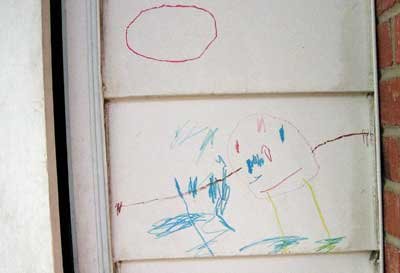
Our kiddo's interest in fine arts has only become stronger over the years. Her skills and technique have developed nicely since first putting crayon to aluminum siding three years ago.

She has dabbled in cubist/surrealist fusion (see "Friendly Alien-2005"), and has produced some fascinating works of abstract expressionism.

The Kiddo's piece is one of only 12 chosen for display from her school.

While I'm proud to say I spotted this talent early, I'm even more proud that other luminaries in the world of fine art also recognize her potential.

If you're out and about in the Crossroads tonight, and if First Fridays is your thing, then don't miss your opportunity to see this up and coming artist.

The work is on display in the Shawnee Mission District Art Show at the OfficePort KC building -- 208 West 19th Street (between Wyandotte and Central).

Just be sure you get there before 8:30. That's her bedtime.

tagged: , , , , , ,

Thursday, April 02, 2009

Read it and weep

In case you missed it, The Atlantic has a great read (penned keyboarded by Simon Johnson) about the covert coup that most people know as the current economic recession.

It's not as expletive-laced or frothing-at-the-mouth as Matt Taibbi's effort, so it might not be as enjoyable to some of you.

But The Atlantic piece does have an air of objectivity to it that makes it more valuable in my opinion (which is the one that counts).

In a primitive political system, power is transmitted through violence, or the threat of violence: military coups, private militias, and so on. In a less primitive system more typical of emerging markets, power is transmitted via money: bribes, kickbacks, and offshore bank accounts. Although lobbying and campaign contributions certainly play major roles in the American political system, old-fashioned corruption—envelopes stuffed with $100 bills—is probably a sideshow today, Jack Abramoff notwithstanding.

Instead, the American financial industry gained political power by amassing a kind of cultural capital—a belief system. Once, perhaps, what was good for General Motors was good for the country. Over the past decade, the attitude took hold that what was good for Wall Street was good for the country. The banking-and-securities industry has become one of the top contributors to political campaigns, but at the peak of its influence, it did not have to buy favors the way, for example, the tobacco companies or military contractors might have to. Instead, it benefited from the fact that Washington insiders already believed that large financial institutions and free-flowing capital markets were crucial to America’s position in the world.

One channel of influence was, of course, the flow of individuals between Wall Street and Washington. Robert Rubin, once the co-chairman of Goldman Sachs, served in Washington as Treasury secretary under Clinton, and later became chairman of Citigroup’s executive committee. Henry Paulson, CEO of Goldman Sachs during the long boom, became Treasury secretary under George W.Bush. John Snow, Paulson’s predecessor, left to become chairman of Cerberus Capital Management, a large private-equity firm that also counts Dan Quayle among its executives. Alan Greenspan, after leaving the Federal Reserve, became a consultant to Pimco, perhaps the biggest player in international bond markets.


tagged: , , , , , ,

Tuesday, March 31, 2009

Playing ketchup

One of the things that's kind of disheartening about the recent economic bump in the road we're all trying to get through is how cavalier people are about throwing around such astronomically huge numbers.

A billion dollars here, a billion dollars there. Pretty soon, your actually talking about real money.

In fact the government so far has committed $11.6 trillion in financial support to failing businesses (banks, auto companies, insurers, mortgage brokers).

Now, $11.6 trillion doesn't really sound like a lot when you say it like that. I mean, sure it sounds large, but c'mon a 't' is much smaller than an 'm' or a "b" -- right? And besides "trillion" has kind of a pretty sound to it. Kind of like a bird singing.

When you write it out numerically, it has a little more impact: $11,600,000,000,000. Whooo! Look at all those zeros!

But I don't think even writing out all of those zeros gives a really good picture of just how much $11.6 trillion is.

To get a better picture of just how large of a number 11.6 trillion is, I like to convert it into a unit that is a little more familiar to regular working class Joes like me. That's right, I like to think of it in terms of tomatoes.

Your typical household garden variety tomato is about 10 centimeters in diameter. So line up 10 of these sweet, juicy bundles of tastiness, and you're looking at 100 centimeters worth of tomatoes. That's one meter for those of you who are products of the Kansas City Missouri school system.

At 100 tomatoes to the meter, you need 10,000 tomatoes to make a kilometer. This is nice to know, because now you can compare the number of tomatoes in various distances. For example, the distance from my house to the Boulevard Brewing Co. tasting room is about 16.25 kilometers. That's a distance of 165,500 tomatoes.

Of course, 165,500 is infinitesimally small compared to 11.6 trillion. So let's think a little larger. The great state of Kansas is 340 kilometers wide. So line up 3,400,000 (3.4 million) tomatoes side by side and you'll get from KC to Hayes and then some. But it's still only a fraction of the 11.6 trillion.

The United States is about 2,600 miles (from New York to San Francisco). That works out to roughly 4,184 kilometers. So you'll need 41,840,000 tomatoes to get from sea to shining sea. But $41.8 million doesn't even cover the mortgage on Bernie Madoff's second house.

Gotta go larger. Gotta think globally.

So, the circumference of the Earth at the equator is about 40,080 kilometers. Converted to tomatoes, that's 400,800,000. So if you had 401 million tomatoes, you could line them up all the way around the world. That's a pretty big number, but you'll note we haven't even reached a billion yet, let alone a trillion.

Earth to the moon is roughly 363,300 kilometers (at perigee). That works out to 3,633,000,000 tomatoes. So if we line up 3.6 billion tomatoes side by side you'll have a row of veggies stretching to the moon. That's a lot of marinara, but we've still got four decimal places to go before we reach the kind of numbers the bailout architects are talking about.

Going out a little farther, the mean distance from Earth to the Sun is 149,300,000 kilometers -- 1,493,000,000,000 tomatoes. Now we're getting some idea of just how large a number like 11.6 trillion is. Consider this, if you had 11.6 trillion tomatoes, you could line up tomatoes side to side and this resulting line of tomatoes would reach from the Earth to the Sun.

In fact, you would have enough tomatoes to make SEVEN lines of tomatoes from the Earth to the Sun. And you would still have millions of tomatoes left over!

So yeah, 11.6 trillion? That, my friends, is a lot of tomatoes.


tagged: , , , , , ,

YouTube Tuesday: My Two Fans

With a few exceptions, many of the most creative video ideas these days are showing up online, not on the air (which seems to be too crowded with fake-reality show knockoffs to allow for any truly original ideas).

Anyway I stumbled onto this newish web series the other day which, in the tradition of God Inc. and others, shows that there are still original and fresh ideas out there. Here's what creator Lauren Iungerich writers on the YouTube channel...
In the brutal world of dating and mating, every single woman needs a fan. Kate Maxwell just happens to have two.

My Two Fans is a new web series from creator, director Lauren Iungerich. The show was inspired after Lauren got "facebooked" by a fan of play she wrote called LOVE ON THE LINE for a charity event during the 2007/8 Writer's Guild strike. After meeting and befriending her fan, Jonathon Roessler, Lauren thought about how all average, single people need fans. And thus the idea for the series was born. My Two Fans is a 16 episode partially- improvised series. All 16 episodes were shot in a span of 4 days.
The series is a bit chick-focused, but it's got pretty good production value for a web series and it's way more entertaining than anything Gray's Anatomy has to offer.


tagged: , , , , ,

Monday, March 30, 2009

The Big Takeover

The other day I read Matt Taibbi's The Big Takeover at Rolling Stone's website.

It is simultaneously one of the most interesting and most scarifying articles I've read on the current state of the economy.

As complex as all the finances are, the politics aren't hard to follow. By creating an urgent crisis that can only be solved by those fluent in a language too complex for ordinary people to understand, the Wall Street crowd has turned the vast majority of Americans into non-participants in their own political future. There is a reason it used to be a crime in the Confederate states to teach a slave to read: Literacy is power. In the age of the CDS and CDO, most of us are financial illiterates. By making an already too-complex economy even more complex, Wall Street has used the crisis to effect a historic, revolutionary change in our political system — transforming a democracy into a two-tiered state, one with plugged-in financial bureaucrats above and clueless customers below.


If you are feeling too optimistic, too upbeat about the current state of affairs, this article is a good antidote. It's something to read while our society self-destructs.

tagged: , , , , , ,

Thursday, March 26, 2009

Guacamole

This public service message goes out to Chimpotle, who is known to combine foods in very disturbing ways.

.

tagged: , ,

Wednesday, March 25, 2009

Expanding vocabulary

The first year of kindergarten is in its home stretch, and I must say it's been a resounding success.

Our kid has made great progress, both academically and socially. It's all that you could hope for as a parent doing this for the first time. Last night, my kid read a story to me before bedtime.

We've always tried to encourage our daughter to be inquisitive, to ask questions and be interested in learning new things.

That's not to say that there haven't been a few surprises along the way, like the time she wanted to dissect a dead snake, for example.

Another such surprise came a few days ago.

I'd just picked up the kiddo from school. She was in the backseat buckled in to her booster and we were going over the highlights of the day.

Then she came at me with this gem:
kiddo: Dad, there's something I wanted to ask you.

me: Okay. What is it.

kiddo: "Is 'ass' a bad word?"

me: Uhh...

me: Um. Well, yeah. It's kind of a bad word.

kiddo: Oh. Okay.

me: Most of the time it's not a nice thing to say. Your mom would probably get mad is she heard you say it.

kiddo: Okay.

me: you should probably look for ways to say what you want to say without using that word?

kiddo: Okay. I haven't said it. I heard someone at school say it, so I just wanted to know if it was bad.
And... scene.

Just a gentle reminder that the teachers aren't the only people teaching our kids at school.

tagged: , , , ,